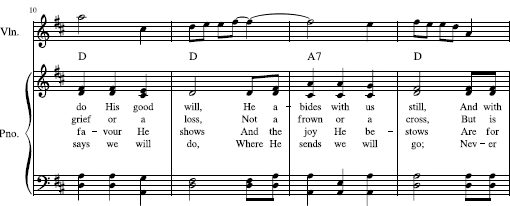
One idea to provide some variations to piano accompaniment in supporting singing voices is on the bass line. The following is an example, being the end of song, or a section of the song, closing with a dominant 7th to tonic.
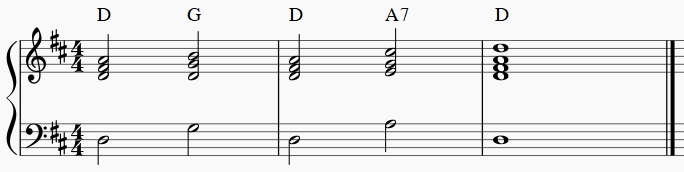
The chords are in first (root) position. The melody flows largely in 1-step motion, except in 2nd bar a 2-step motion from A to C#. The bass line for the second bar, D to A is ok too, but there’s a slight hint of all harmony moving in the same direction which I would keep an eye on – but the resolution from A7 to D balances the previous D to A7, with the melody going up 1 step: C# to D, while all other notes going contrary motion.
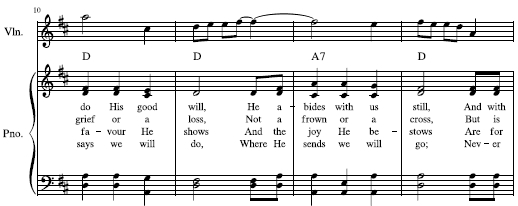
What variation is possible here? Here is an example:
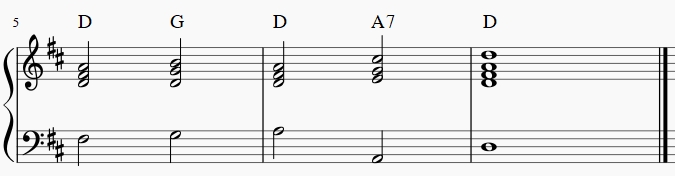
First chord, I play F# on the bass instead of D. This gives a slight harmonic ‘hinge’ – it has stability of a tonic harmony but has a slight level of potential energy for moving forward. The resultant F# – G, being a 1 step movement on the bass, is mirrored in the melody A to B, also 1 step. You then achieve a third relationship between the bass and the melody.
Further, you can proceed the bass line with another 1 step, from G to A, to the D chord in the second bar. Here, you get a contrary motion between the bass and melodic lines: the bass going up from G to A, the melody going down from B to A. This kind of subtleties can be important to give interest to the music.
Going on, we can do an octave jump down on the bass line in the bass line, A to A. This way, we balance out the small harmonic parallel movement (all notes going the same direction) of the second bar in Music 001. The lower register of the second A bass note gives a stronger feel to the ending too.